Lipce Forest Conflict and the Arrest of the Peasants
The PeasantsThe Lipce Forest Conflict and the Arrest of the Peasants turn a dispute over woodland into a village-wide confrontation with the manor and the authorities. The squire’s felling of the forest, combined with his refusal to hire Lipce workers, draws farmers and hired hands into a mass effort to defend what they consider their rights. The ensuing response sends more than fifty men to prison: collective action becomes visible, but its cost falls on households and fields left behind.
Causes and Stakes
The conflict grows from both a claim to the forest and a crisis of livelihood. The squire decides to sell the wood without negotiating with the peasants, whom the narrative presents as co-owners. Villagers object not only to the cutting but to an arrangement that, in their view, lets the manor’s debts and the sale of its lands favor financially stronger buyers while excluding them from the market and its benefits. A shared economic grievance might have united the community, yet suspicion and competition among neighbors repeatedly work against that possibility.
The dispute sharpens when the squire refuses to employ local men for the felling. During a hard winter, at least twenty hired hands are desperate for work; potatoes have frozen for some, money is scarce, and the coming preharvest period threatens hunger. Villagers had expected the logging at Wolf’s Hollow to provide employment. Instead, they hear that no one from Lipce will be hired, apparently because a complaint has been lodged against the squire. Boryna insists that the wood must not be cut until the manor reaches an agreement with them and gives them what they claim is theirs. The forest is thus at once a customary resource, a source of wages, and a test of whether the manor will recognize the village’s claims.
The Mobilization
When news spreads that the squire is felling the peasants’ forest, many at first refuse to believe it. The timing seems wrong: it is mid-March, the ground is thawing, and the sap is beginning to rise. But as the news takes hold, villagers gather outside the inn and wait for Boryna, regarded as the first farmer and the person whose leadership no one would bypass. The blacksmith and the miller warn that the village could end up in jail, but the crowd distrusts their intervention, believing both men to have interests of their own with the manor.
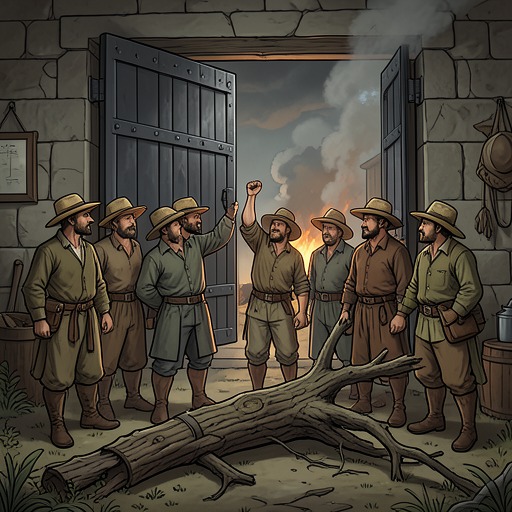
Boryna addresses the crowd by naming the accumulated injuries behind the immediate dispute: the manor is cutting the forest, has refused them work, and has repeatedly harried them. Complaints and court proceedings, he says in effect, have achieved nothing; the villagers must defend their rights together. The response is a shout for the forest. People hurry home to change and prepare, harnessing horses and dragging out sleighs. Farmers, hired hands, women, and older children join the march, some on sleighs, horses, or carts and many on foot. They carry stout poles, pitchforks, flails, and, in places, scythes. At the poplar road, Boryna waits with Płoszka, Kłąb, and other leaders; he crosses himself and gives the signal to go.
Confrontation and Arrests
The march is the conflict’s clearest image of collective resolve: a crowd that had gathered in watchful silence moves as a body toward the forest, armed with ordinary farm tools. Yet the mobilization does not become a lasting political transformation. The battle with the squire’s people and the subsequent response of the Russian imperial local authorities result in more than fifty men being driven to prison. The scale of the arrests makes the danger anticipated by the blacksmith concrete, even though his warning had failed to turn the crowd back.
The episode also shows how political exhortation can intensify grievance without resolving its causes. Rocho’s words stir memories of injuries between the people and their masters, reviving anger rather than offering a remedy. In the larger course of the novel, the conflict does not produce a sustained uprising or a unified peasant political movement. The village’s economic claim is momentarily spoken and acted upon as a common cause, but resentment, mistrust, and the unequal distribution of risk continue to divide its inhabitants.
The Village During the Men’s Absence
The imprisonment removes a substantial part of the village’s labor force at a time when households and fields need it. The consequences reach beyond the arrested men: some families face hunger, others lack anyone to work their land, and spring arrives with fields standing fallow. Hanka, previously timid, takes up responsibilities left by Boryna and Antek and becomes a forceful manager of the farm. Her rise shows how the absence of men can unsettle the established order and make women’s authority more visible.
The crisis also prompts acts of help, though not evenly. Szymek eventually breaks from Dominikowa’s control, leaves home, and marries a much poorer girl, with material support from the village. Neighbors from surrounding villages arrive to offer free labor, an unusual gesture that briefly suggests a more generous community. But the poorest women, including those working as hired hands, receive no comparable help. Their appeals describe hunger, illness, births without adequate support, and families without anyone available to work the land; neither the priest nor Rocho provides the immediate relief they seek. The forest conflict therefore discloses both the possibility of solidarity and its limits. Once the imprisoned men return and Jagna is banished, the temporary disturbance subsides and the village’s familiar social order reasserts itself.